
I started this post in Qatar waiting for my connection to Hyderabad. My goal is to publish 7 blog posts in 7 days, and share some personal/travel stuff along with the technical content you usually see here.
Today’s article is a short article, around one of our newest features, introduced in version 25.4 (changeLog) of the SQL Developer Extension for VS Code –
- Create a table
- Edit table
We’ve brought you the editor you’ve seen before in SQL Developer and SQL Developer Web.
Tables are JUST the start, next you can expect views and other popular schema objects to appear.
Let’s make a table
There are actually two new interfaces for creating new tables, but for now, ignore the ‘Import Data’ menu item.
Note this opens as a document, not a pop-up modal dialog. This brings many benefits besides just feeling more modern. For starters, I can open multiple of these tasks or switch between them.
To get started, just ‘right click’. If on a table node you will see this:

I simply clicked the ‘+ Add’ button half a dozen times and then filled in the details as required.
Some comments –
- type the column name directly
- reorder columns using the Top/Bottom controls
- ‘check your work’ periodically by going to the DDL page
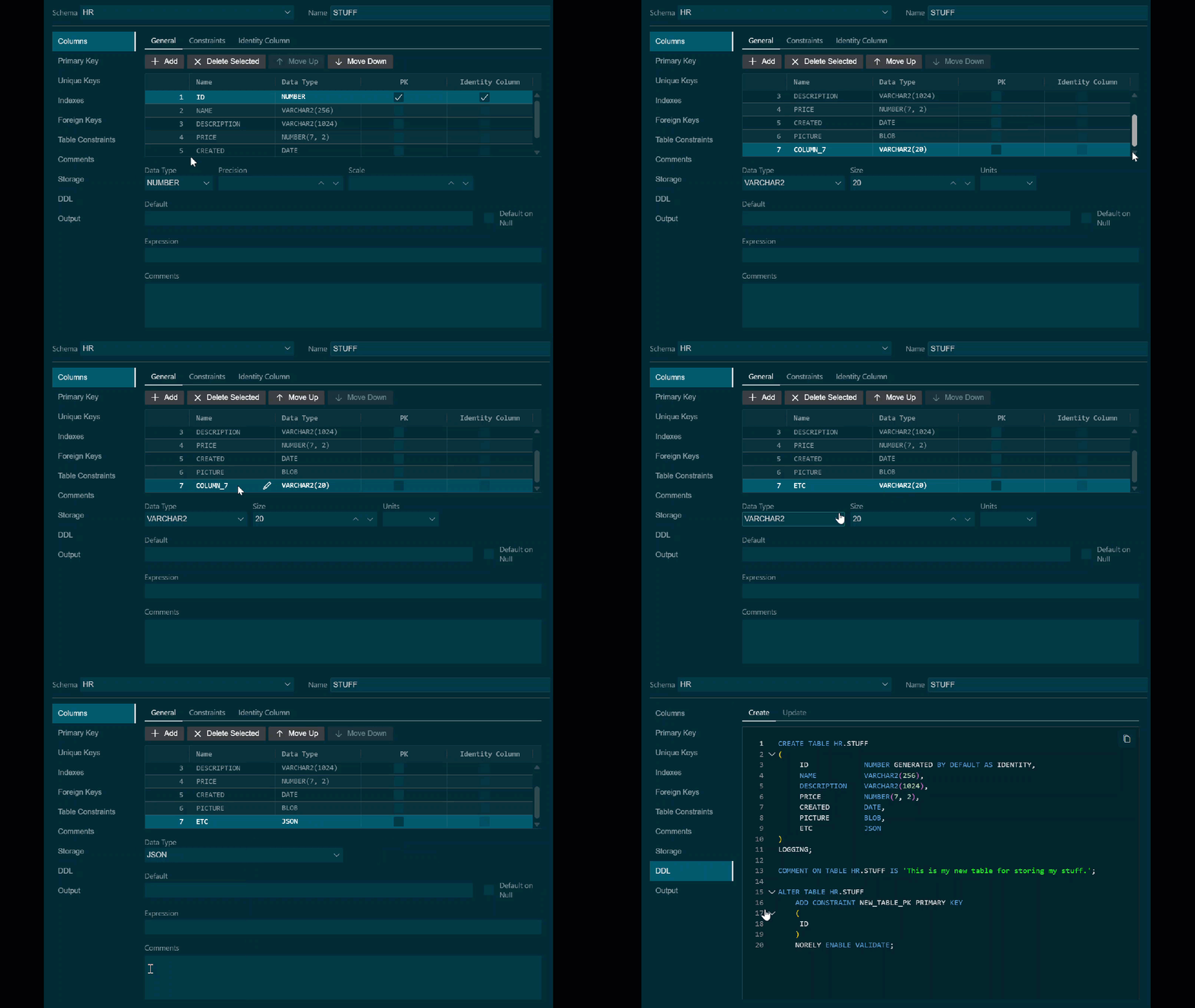
If you click ‘Apply’, we’ll do the work and display the results in the Output panel. You can do it iteratively, so if you run into problems, you don’t have to start from the beginning.

This is also useful if you are in the Edit dialog for an existing table. Another nice thing about editing tables is that DDL pages can display CREATE and ALTER syntax.

The post Working with tables in Oracle SQL Developer for VS Code first appeared on ThatJeffSmith.
PakarPBN
A Private Blog Network (PBN) is a collection of websites that are controlled by a single individual or organization and used primarily to build backlinks to a “money site” in order to influence its ranking in search engines such as Google. The core idea behind a PBN is based on the importance of backlinks in Google’s ranking algorithm. Since Google views backlinks as signals of authority and trust, some website owners attempt to artificially create these signals through a controlled network of sites.
In a typical PBN setup, the owner acquires expired or aged domains that already have existing authority, backlinks, and history. These domains are rebuilt with new content and hosted separately, often using different IP addresses, hosting providers, themes, and ownership details to make them appear unrelated. Within the content published on these sites, links are strategically placed that point to the main website the owner wants to rank higher. By doing this, the owner attempts to pass link equity (also known as “link juice”) from the PBN sites to the target website.
The purpose of a PBN is to give the impression that the target website is naturally earning links from multiple independent sources. If done effectively, this can temporarily improve keyword rankings, increase organic visibility, and drive more traffic from search results.
Comments are closed, but trackbacks and pingbacks are open.